
Starting March 1st, Japanese semiconductor materials giant Resonac raised prices for copper clad laminate (CCL) and adhesive films by over 30%. The company stated that despite implementing various cost optimization measures, the continued shortage and price increases of key raw materials such as fiberglass cloth, epoxy resin, and copper foil necessitated this price adjustment to ensure stable product supply and investment in new technology research and development.
As a major global supplier of CCL and copper clad laminate adhesive materials, Resonac’s price increase will impact high-end manufacturing segments such as MLCCs, HDI boards, IC substrates, and high-frequency, high-speed PCBs.
Copper clad laminate is a core raw material for PCBs, with upgrades to traditional servers and the penetration of AI servers driving both increased volume and price of copper clad laminates. Copper clad laminate accounts for approximately 30% of the raw material cost of PCBs. Prismark projects a compound annual growth rate of 5.40% for global PCB production value from 2024 to 2028. The server/memory sector is projected to grow at 13.6%.
The Dongguan Securities electronics team believes that considering the continued high raw material prices, the high overall utilization rate of downstream PCBs, the crowding out of conventional capacity by AI copper-clad laminate (CCL) products, and the relatively concentrated market share of CCL manufacturers, the price adjustment trend for CCL products is expected to continue, and the performance and profitability of related companies are expected to rise steadily.
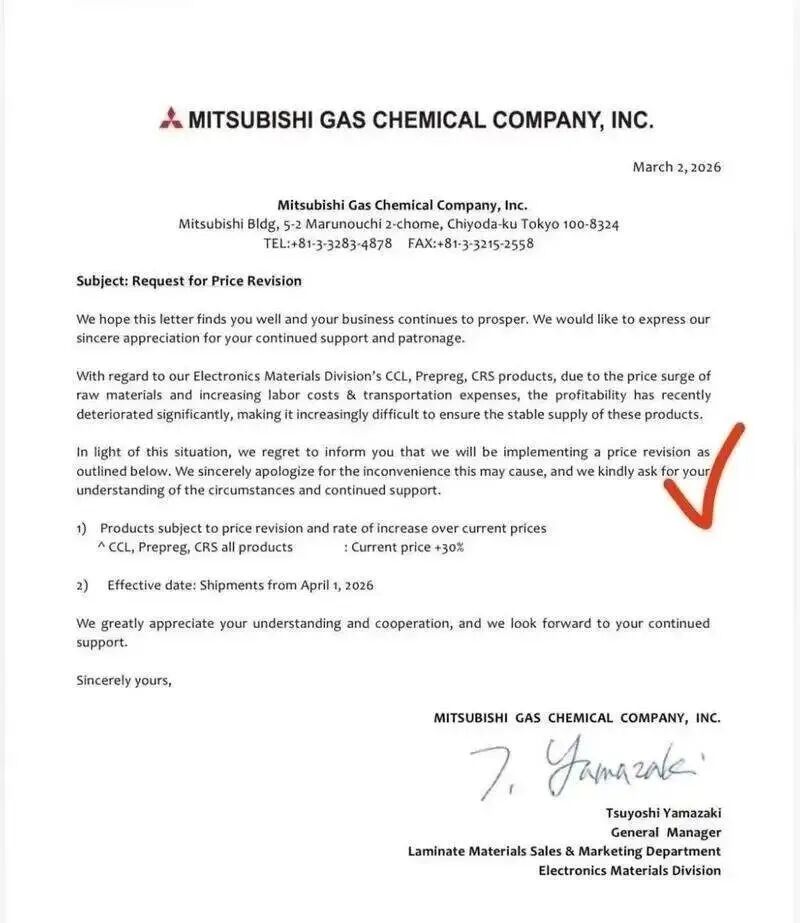
On the evening of March 2nd, Mitsubishi Gas Chemical announced a 30% price increase for CCL starting April 1st; previously, Resonac also announced a price increase for PCB materials such as copper foil substrate (CCL) and adhesive films, also exceeding 30%, effective March 1st.
Copper-clad laminate (CCL) is a core raw material for PCBs, accounting for approximately 30% of the total cost. With the successive launches of next-generation AI computing platforms, the requirements for high-speed, high-frequency materials have significantly increased. PCB transmission materials are upgrading from M6 and M7 grades to M8+ and M9 grades.
However, there are only a few companies capable of mass-producing high-end CCLs. The fact that Japanese companies have taken the lead in raising prices indicates, to some extent, that the supply of high-end products is not abundant, and bargaining power is shifting back to the materials side.